
From Planning to Performance: Why the Best Projects Are Won Before Execution Begins Why do…
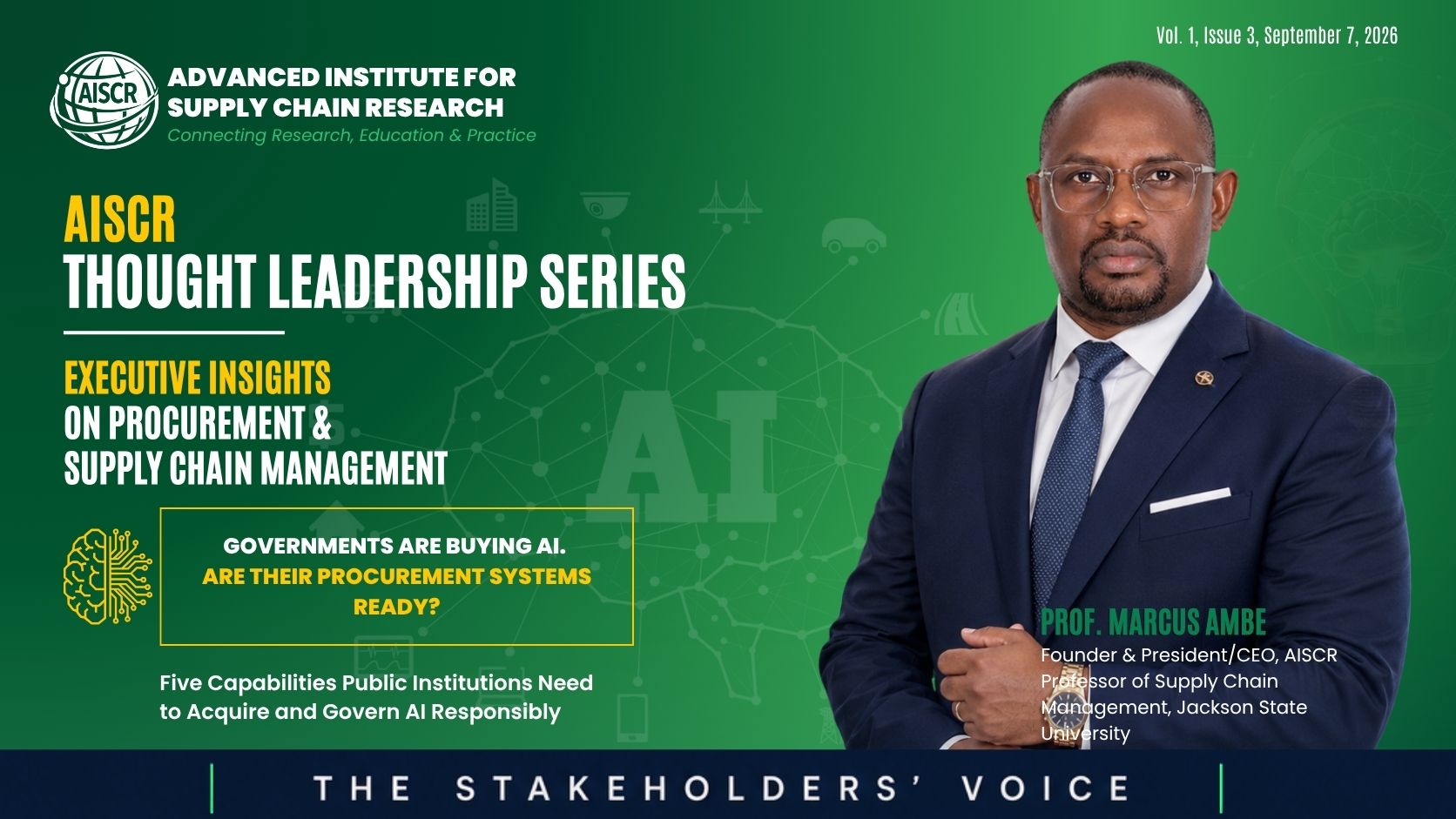
Governments Are Buying AI. Are Their Procurement Systems Ready?
Governments Are Buying AI. Are Their Procurement Systems Ready?
Why institutional capability, not technology alone, will determine whether public-sector AI delivers value
Governments are rapidly acquiring artificial intelligence to automate processes, analyze data, identify risks, improve decision-making, and strengthen public-service delivery. Yet behind this growing technological ambition lies a critical institutional question:
Do public institutions have the procurement capability to acquire, evaluate, govern, and manage AI responsibly?
Drawing on findings from the U.S. Government Accountability Office and his research on institutional readiness, Prof. Marcus Ambe examines how AI is changing the demands placed on public procurement systems. AI acquisitions present challenges that extend beyond conventional purchasing. Procurement teams must be able to assess complex supplier claims, evaluate the suitability of data and technology, understand total lifecycle costs, protect government data and intellectual property, manage cybersecurity risks, prevent excessive vendor dependence, and monitor systems whose performance may change over time. The article argues that public institutions cannot effectively evaluate technologies they are not sufficiently equipped to interrogate. Procurement professionals do not need to become data scientists or software engineers, but they must work within multidisciplinary teams that combine procurement, technical, legal, financial, cybersecurity, data-governance, and operational expertise.
Five Pillars of AI Procurement Readiness
At the center of the article is a five-pillar framework for institutional readiness:
- Leadership and governance: Establishing clear accountability, oversight, policies, and decision-making structures.
- Digital infrastructure: Ensuring systems are secure, scalable, interoperable, and capable of supporting AI.
- Workforce capacity: Building the multidisciplinary expertise required to define needs, evaluate solutions, and manage contracts.
- Data readiness: Ensuring that institutional data are reliable, accessible, secure, and suitable for their intended purpose.
- Ethical safeguards: Addressing fairness, transparency, privacy, accountability, explainability, and auditability.
These capabilities are interconnected. An institution may acquire advanced technology but still lack the workforce, data, governance, or contractual protections necessary to use it effectively. A weakness in any one pillar can undermine the value, accountability, and sustainability of the entire acquisition.
Building Institutions Around Technology
The article also considers what these developments mean for African governments as digital procurement and AI-enabled public services expand across the continent. Technology should not be treated as a substitute for procurement reform or institutional development. Investment in AI must be matched by investment in professional capability, data governance, contract management, system integration, ethical oversight, and institutional learning.
The central message is clear:
AI will not automatically correct a weak procurement system. Governments will realize its value only by building capable institutions around the technology they acquire.
Ultimately, public-sector AI should be judged not by how many systems governments purchase, but by whether institutions can govern those systems, hold suppliers accountable, learn from implementation, and translate technological capability into sustainable public value.
AI readiness must also mean procurement readiness.

Related Posts