The African Continental Free Trade Area (AfCFTA) provides the framework and the market for continental…
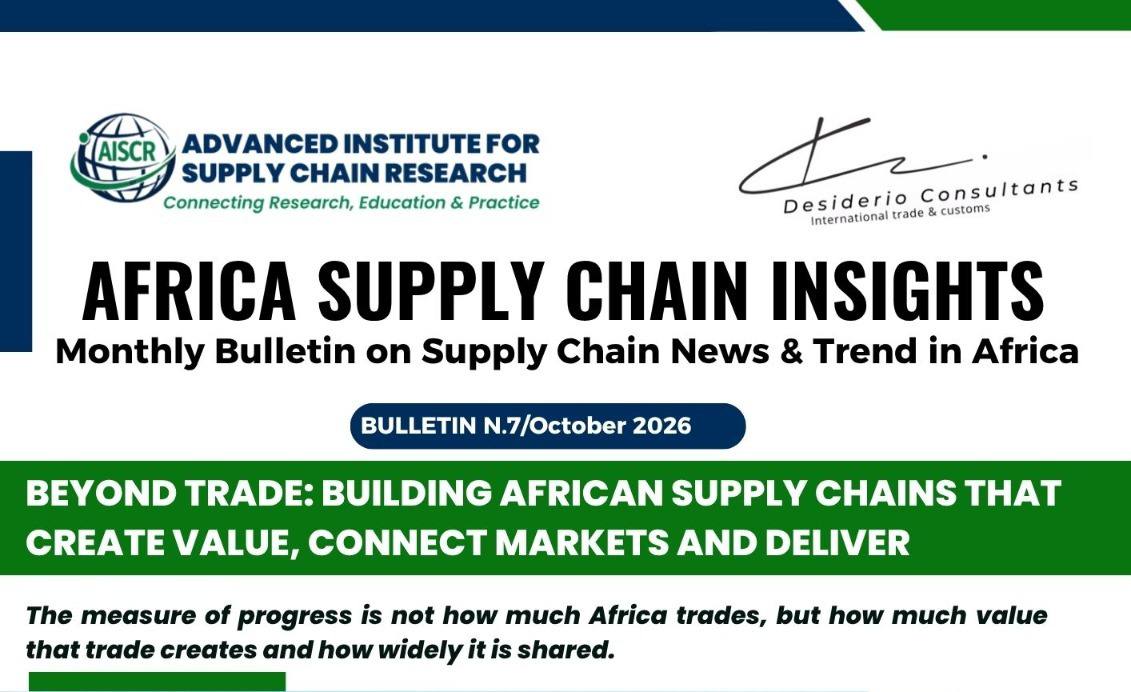
AISCR-Desiderio Africa Supply Chain & Energy Bulletin Edition 7, October 2026
Africa Supply Chain & Energy Bulletin, Edition 7 (October 2026)
A joint publication by Desiderio Consultants & AISCR
Building African Supply Chains That Create Value, Connect Markets and Deliver Inclusion
Africa’s supply chain challenge is not only about moving goods faster or cutting border delays. It is about building an economic system in which businesses can produce, finance, transport and trade efficiently, and in which the benefits reach local enterprises, workers and communities. Edition 7 explores this theme through five stories:
- Financing Kenya’s MSMEs: A new digital supply chain finance platform, Easetrade, aims to disburse US$150 million in loans to around 5,000 MSMEs over three years. It uses data-driven credit scoring, invoice discounting and dealer finance to close the gap between market access and the working capital needed to fulfil orders.
- East Africa Foods raises US$40 million: The Tanzanian agritech company is expanding the physical and digital infrastructure that links smallholder farmers to urban retailers. The story shows that food loss is as much an infrastructure problem as a production problem.
- From factories of production to factories of possibilities: Industrialisation should be judged by the skills, suppliers and productive capabilities it builds across the economy, not only by factory output.
- Critical minerals and accountability: The 5th Africa Business and Human Rights Forum in Dakar called for stronger due diligence, traceability and access to remedy, so that communities share fairly in the benefits of the energy transition.
- Raw material export bans: Five West African countries have restricted raw shea-nut exports to promote local processing. The lesson is that trade policy must be matched by industrial policy, including energy, finance and market development.
This edition also features a synthesis of Danilo Desiderio’s presentation at the AISCR webinar on trade, transport and border delays. It looks at how export diversification, digital freight platforms and corridor management can reduce empty backhauls and transport costs.
The takeaway: The measure of progress is not simply how much Africa trades, but how much value that trade creates and how widely its benefits are shared.
↓ Download the AISCR-Desiderio Africa Supply Chain & Energy Bulletin Edition 6, September 2026

Related Posts