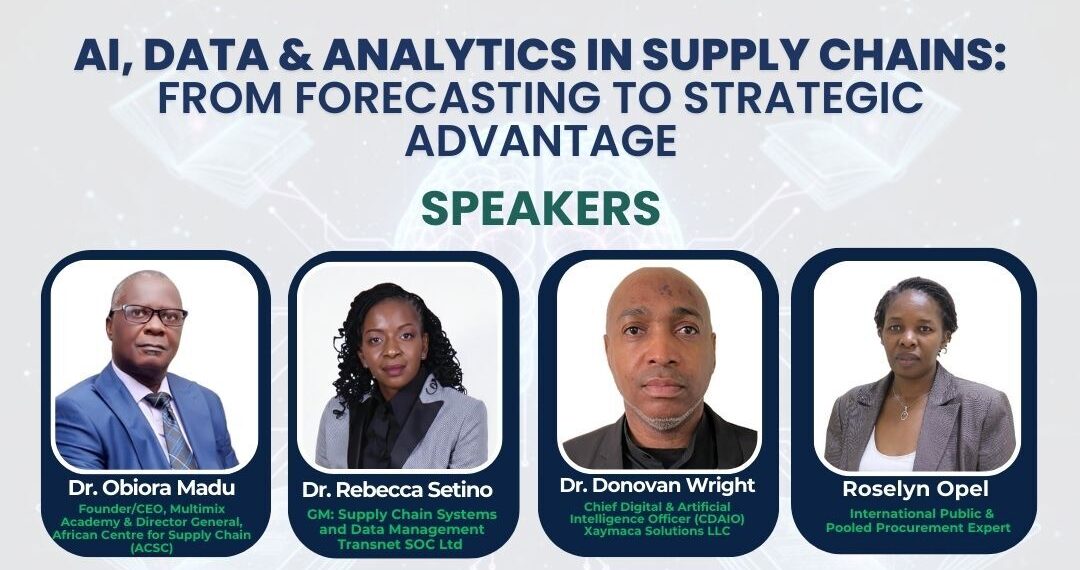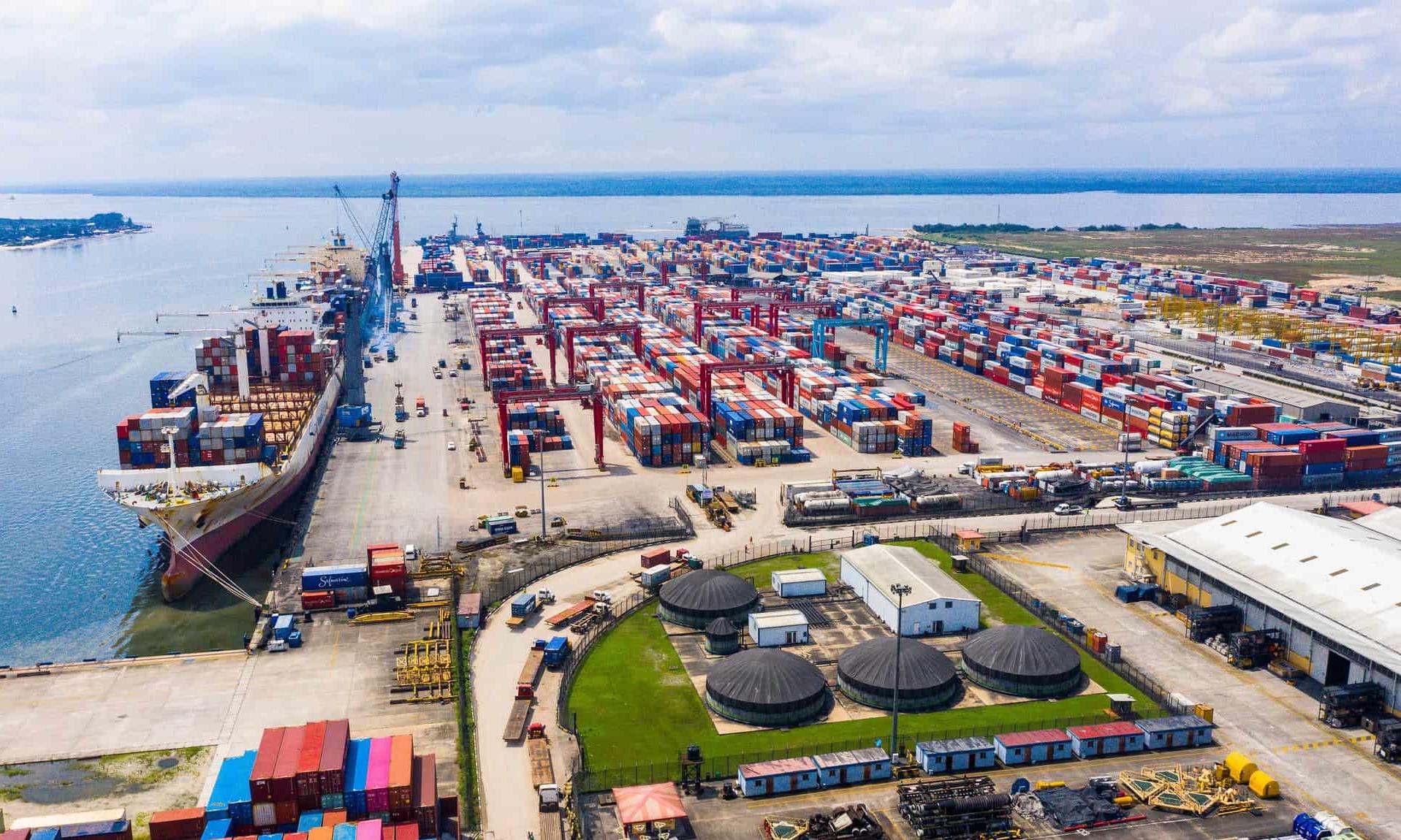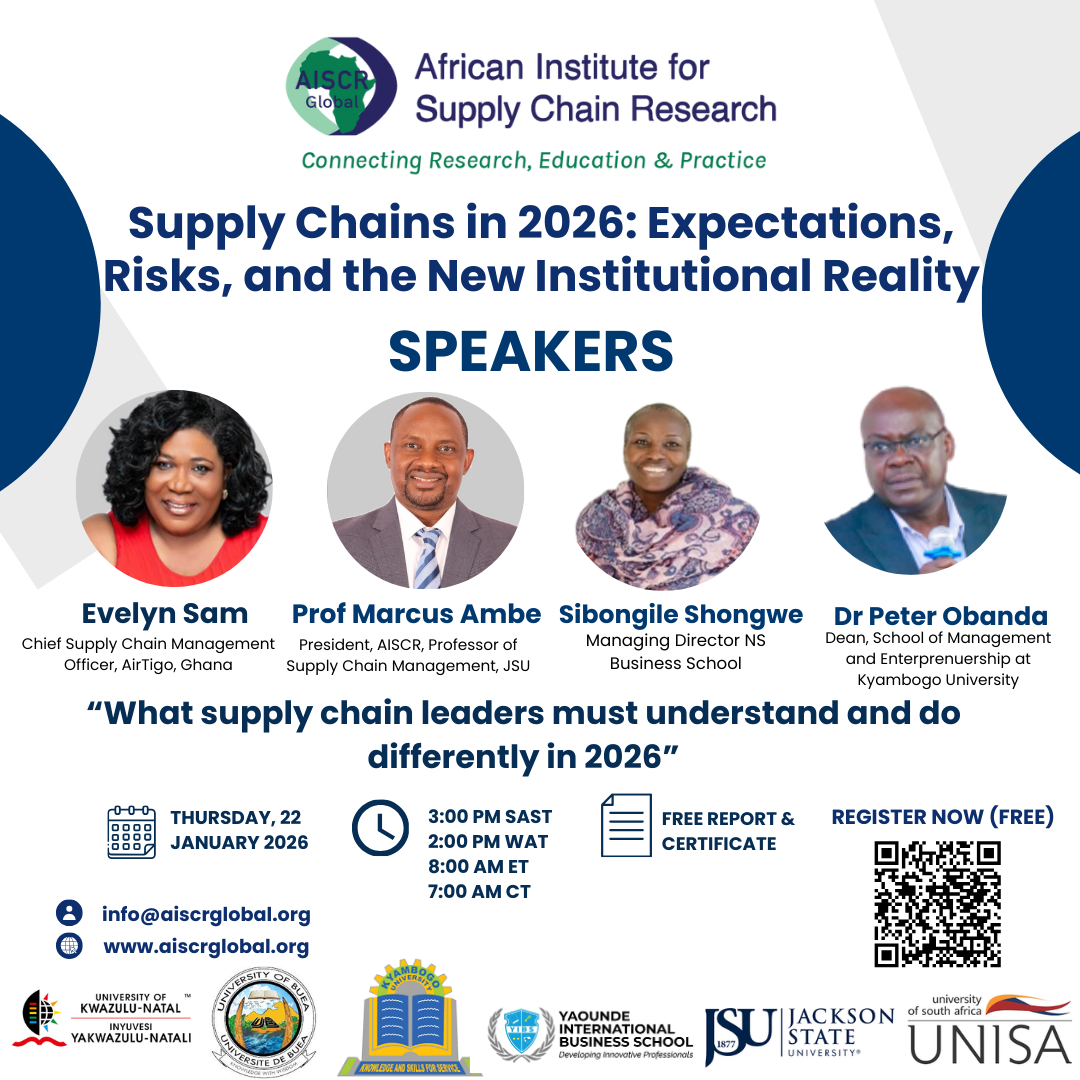
AI, Data & Analytics in Supply Chains: From Forecasting to Strategic Advantage Live Executive Webinar |…
Supply Chains in 2026: Expectations, Risks, and the New Institutional Reality Synthesis of the AISCR Inaugural Webinar
Supply Chains in 2026: Expectations, Risks, and the New Institutional Reality
Synthesis of the AISCR Inaugural Webinar, January 22, 2026
About this Brief
This Executive Insight Brief synthesizes senior-level perspectives presented at the AISCR inaugural webinar, Supply Chains in 2026: Expectations, Risks, and the New Institutional Reality, held on January 22, 2026. Drawing on contributions from leading scholars and senior practitioners, the brief distills strategic, institutional, and governance-oriented insights relevant to policymakers, boards, and executive leadership teams. Rather than summarizing individual presentations, the brief integrates their underlying analytical logic to provide a coherent interpretation of how supply chains are being structurally reshaped, and what these changes imply for Africa and other institutionally exposed regions. The document is designed as a standalone decision-support resource, consistent with AISCR’s mission to advance applied, policy-relevant, and institutionally grounded knowledge.
- Executive Summary
By 2026, global supply chains are no longer defined by recovery from disruption, but by the permanent normalization of volatility and the institutionalization of risk. The efficiency-driven global supply chain model that dominated from the mid-1990s through the mid-2010s has been structurally displaced. In its place has emerged a system governed by geopolitical alignment, regulatory intervention, industrial policy, and data control. Across the webinar discussions, a clear conclusion emerged: risk has migrated from the operational domain to the institutional domain. Supply chains are now shaped less by firm-level optimization and more by political economy, regulatory architecture, and organizational design. As a result, resilience can no longer be treated as a contingency function; it has become a core strategic and governance responsibility.
For Africa, this transition presents a dual and asymmetric reality. Global reconfiguration, through regionalization, diversification, and re-shoring, creates potential entry points into evolving supply chain architectures. Yet Africa’s limited influence in global rule-setting, combined with high dependence on imported essentials, means shocks are transmitted rapidly and unevenly. The binding constraint is not cost competitiveness, but institutional readiness: the capacity to govern, coordinate, and execute within a rules-intensive global system. This brief articulates the central insights from the webinar, examines their implications for African institutions, and outlines AISCR’s forward agenda.
| Efficiency-Driven Model (1995–2015) | Structural Breaks (2018–2024) | Governed Supply Chains (2026+) |
| Cost minimization | Trade wars & tariffs | Risk governance |
| Global sourcing | Pandemic disruption | Strategic control |
| Just-in-time efficiency | Sanctions & export controls | Institutional coordination |
| Firm-level optimization | ESG & data regulation | Regulated ecosystems |
Figure 1. The End of the Efficiency Era: Structural Shift in Global Supply Chains
- Key Insights from the Webinar
Insight 1: 2026 is a consolidation year, not a recovery year
The premise of a return to pre-pandemic supply chain norms is analytically unsound. While global trade volumes may stabilize, the underlying architecture of trade and production has fundamentally changed. Export controls, sanctions regimes, localization requirements, ESG compliance, and industrial subsidies are now enduring features of the system. Organizations are therefore consolidating new operating models rather than reverting to legacy ones.
Insight 2: Risk has shifted decisively from operations to institutions
Operational risks, such as demand volatility, logistics bottlenecks, and supplier failure, remain relevant but are increasingly dominated by policy risk, regulatory surprise, and geopolitical realignment. These risks originate largely outside the firm and cannot be mitigated through operational excellence alone. Effective response requires institutional coordination, board-level oversight, cross-functional governance, and sustained engagement with regulators and ecosystem partners.
| Operational Risk (Legacy) | → | Institutional Risk (2026) |
| Demand variability | Trade & industrial policy | |
| Transport disruption | Sanctions & export controls | |
| Inventory mismatch | ESG & compliance regimes | |
| Supplier failure | Data governance & sovereignty |
Figure 2. Risk Migration Map: From Operational to Institutional Risk
Insight 3: Fragmentation has replaced globalization as the organizing logic
Global supply chains are being restructured into regional, political, and strategic blocs. Near-shoring, friend-shoring, and multi-tier supplier diversification are no longer tactical options but baseline governance expectations. Single-country or single-supplier dependencies are increasingly viewed as failures of oversight rather than efficiency choices.
Insight 4: Technology is both an accelerator and a divider
Advanced analytics, artificial intelligence, predictive planning, and digital traceability are redefining how organizations anticipate risk and allocate resources. However, uneven adoption is widening structural performance gaps. Organizations and countries without robust data governance frameworks, interoperable systems, and digitally skilled talent risk exclusion from high-value segments of global supply chains.
Insight 5: Institutions not firms now determine resilience outcomes
Resilience is increasingly shaped by the quality of procurement systems, contract design, regulatory coherence, infrastructure reliability, and organizational structure. Firms embedded in weak institutional environments experience amplified shocks regardless of managerial intent. Conversely, strong institutions absorb volatility and convert resilience into strategic advantage.
Insight 6: Africa’s exposure is increasing faster than its preparedness
Africa represents a small share of global trade yet absorbs a disproportionate share of shock transmission through inflation, food insecurity, health system strain, and service delivery disruption. The central challenge is not integration per se, but the absence of coordinated institutional capacity across governance, logistics, skills, data systems, and regional mechanisms such as AfCFTA.
| Dimension | Exposure Level | Institutional Readiness |
| Trade dependence | High | Uneven |
| Food & health imports | High | Low–Moderate |
| Regulatory influence | Low | Low |
| Digital infrastructure | Rising | Fragmented |
Figure 3. Africa’s Exposure–Readiness Gap
- Implications for Africa and Institutions
Core Insight:
Resilience is determined by institutional capacity, not intent.
Policy Implications
Governments must move beyond aspirational policy frameworks toward operational institutional readiness. Trade policy, industrial strategy, logistics infrastructure, and procurement systems must be aligned and executed coherently. Regional integration initiatives will only translate into supply chain resilience if supported by harmonized rules, enforcement mechanisms, and implementation capacity.
Organizational Implications
Organizations must reposition supply chain and procurement functions from operational support units to strategic governance platforms. Board-level visibility, enterprise-wide risk accountability, and cross-functional integration are now essential. Supplier relationships must evolve from transactional arrangements toward capability-building and risk-sharing partnerships.
Professional and Workforce Implications
The supply chain leader of 2026 is a system designer, not an operator. Demand is increasing for professionals with competencies in risk governance, regulatory navigation, data analytics, and institutional coordination. Traditional training models focused narrowly on tools and techniques are insufficient; applied, enterprise-level capability development is required.
- What We Asked You: Survey Preview
To complement expert dialogue with practitioner evidence, AISCR conducted a post-webinar survey examining:
- Anticipated supply chain risks toward 2026
- Institutional readiness across policy, organizations, and talent
- Technology adoption and data capability gaps
- Priority areas for capacity building and applied research
The survey is intended to ground strategic dialogue in empirical insight. Findings will be released in a separate AISCR Insight Note.
- What We Asked You: Survey Preview
AISCR conducted survey examining:
- Anticipated supply chain risks toward 2026
- Institutional readiness across policy, organizations, and talent
- Technology adoption and data capability gaps
- Priority areas for capacity building and applied research
Findings will be published in a separate AISCR Insight Note. AISCR invites institutions, organizations, and professionals to engage in shaping resilient, institutionally grounded, and strategically governed supply chains.
Webinar Contributors
This Executive Insight Brief draws on perspectives shared during the AISCR inaugural webinar held on January 22, 2026. The synthesis reflects the collective insights of the following contributors:
- Prof. Marcus Ambe
President, African Institute for Supply Chain Research (AISCR)
Professor of Supply Chain Management, Jackson State University - Dr. Peter Obanda
Dean, School of Management and Entrepreneurship
Kyambogo University, Uganda - Ms. Evelyn Sam
Chief Supply Chain Management Officer
AirTigo, Ghana - Ms. Sibongile Shongwe
Managing Director, NS Business School, South Africa
The synthesis, interpretation, and framing presented in this brief are those of AISCR and do not necessarily represent the individual views of the contributors.
CLICK HERE TO DOWNLOAD THE AISCR EXECUTIVE BRIEF

Related Posts