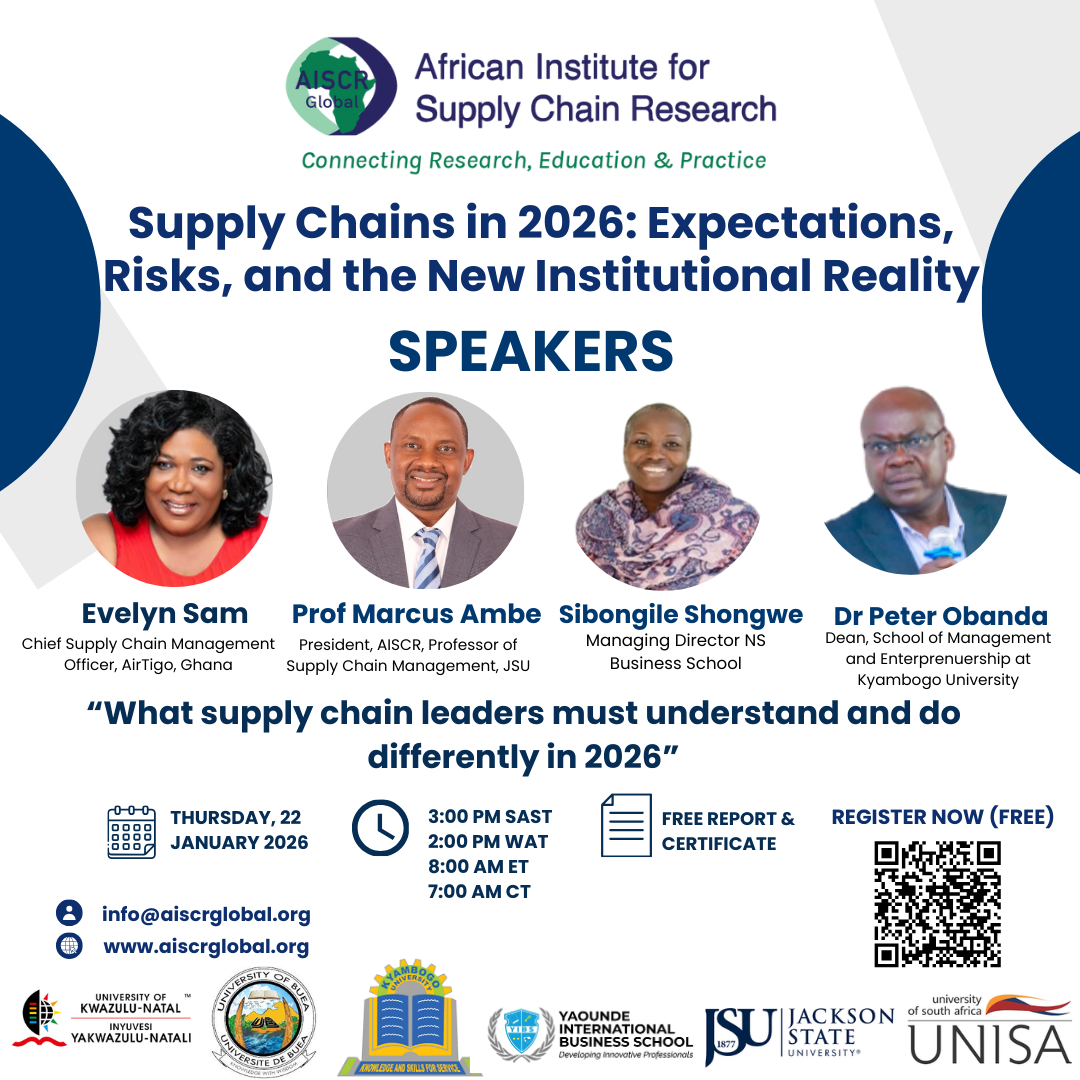
AI, Data & Analytics in Supply Chains: From Forecasting to Strategic Advantage Live Executive Webinar |…
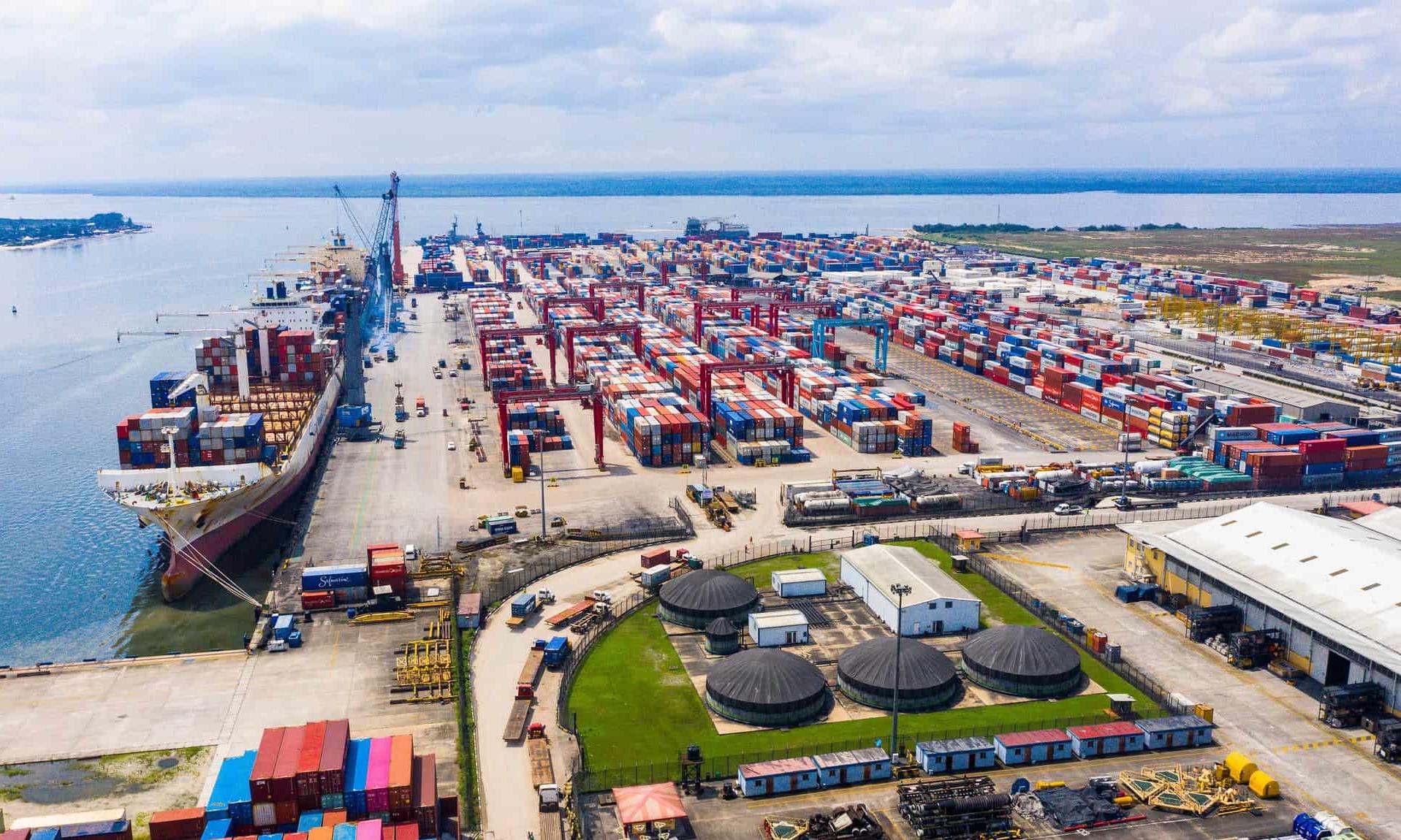
Africa’s Hidden Giants: Why Institutional Supply Chains Will Shape the Continent’s Next Decade
Africa’s Hidden Giants: Why Institutional Supply Chains Will Shape the Continent’s Next Decade
AISCR’s Research Perspective
Introduction
Africa’s economic narrative is often framed around entrepreneurship, innovation hubs, and technology startups. These dynamics are important and necessary for job creation and innovation. However, this framing can obscure a fundamental reality: Africa already possesses significant corporate and institutional scale. Recent evidence from the McKinsey Global Institute indicates that Africa is home to more than 300 large companies with annual revenues exceeding USD 1 billion, concentrated primarily in South Africa, but also in Nigeria, Egypt, and Morocco. These are not speculative startups; they are established, revenue-generating enterprises embedded in the real economy. Yet despite this scale, Africa continues to be perceived by global capital markets as a high-risk environment. This disconnect suggests that the continent’s binding constraint is not a lack of enterprise, but rather insufficient institutional readiness, particularly in capital markets, governance frameworks, and supply chain systems. This perspective does not discount entrepreneurship or innovation. Rather, it recognizes that startups and emerging firms cannot scale, survive, or transform economies without strong institutional systems beneath them.
From Startups to National Champions
Development economics has long emphasized the role of national champions, large firms in manufacturing, logistics, energy, finance, agribusiness, and services that anchor employment, fiscal revenues, and industrial ecosystems. In many regions, these firms serve as the backbone of economic resilience and productivity growth. In Africa, however, capital markets remain shallow, fragmented, and unevenly developed. The OECD’s Africa Capital Markets Report 2025 shows that a small number of countries account for the majority of market capitalization and corporate issuance, while most firms remain dependent on bank finance, development finance institutions, or foreign capital. This structure limits firms’ ability to:
- Invest over long time horizons
- Absorb systemic risk
- Scale operations across borders
- Integrate regionally under the African Continental Free Trade Area (AfCFTA)
Even where operational capacity and market demand exist, institutional bottlenecks constrain growth.
Why Capital Hesitates
Institutional investors prioritize predictability. This includes:
- Clear governance and regulatory frameworks
- Enforceable contracts and dispute resolution mechanisms
- Transparent reporting and data availability
- Reliable procurement, logistics, and operational systems
- Where these conditions are weak or inconsistent, capital prices in risk.
The OECD (2025) identifies weak investor protection, limited liquidity, regulatory fragmentation, and underdeveloped corporate bond markets as key contributors to Africa’s elevated risk premium. Similarly, the African Development Bank’s African Economic Outlook 2025 emphasizes that sustaining growth depends not only on increasing capital inflows, but on improving institutional quality, governance, and investment frameworks. In this context, Africa is often mispriced, not because it lacks productive firms, but because it remains institutionally difficult for investors to assess, monitor, and trust.
The Institutional Opportunity
The joint African Union Commission–OECD report, Africa’s Development Dynamics 2025, argues that the continent’s next phase of transformation will be driven by:
- Productivity gains
- Regional integration
- Institutional capacity
Particularly critical are improvements in:
- Trade facilitation
- Regulatory harmonization
- Public sector effectiveness
- Infrastructure governance
Supply chains sit at the center of this transformation. Procurement systems, logistics networks, standards, certification regimes, contract management, and trade facilitation mechanisms are the channels through which production becomes trade, and trade becomes investment. Without these systems, economic scale remains fragmented, localized, and under-leveraged.
Implications for Policy and Institutional Reform
The evidence points to several policy-relevant implications:
- Supply chain institutions are investment infrastructure.
Procurement systems, logistics governance, and contract management frameworks shape investor confidence as much as financial regulation. - Institutional diagnostics matter.
Measuring procurement maturity, logistics performance, and governance readiness is a prerequisite for reform and capital mobilization. - AfCFTA implementation is operational, not symbolic.
Regional integration depends on interoperable standards, professionalized systems, and cross-border coordination. - Human capital and professionalization are systemic needs.
Leadership capability, ethics, and technical competence determine whether institutions function predictably.
AISCR’s Institutional Mandate
This is the institutional space in which the African Institute for Supply Chain Research (AISCR) operates.
AISCR’s mandate is to strengthen Africa’s supply chain and procurement institutions by:
- Generating rigorous, policy-relevant research
- Developing diagnostic tools, indices, and benchmarking frameworks
- Supporting governments and firms to professionalize systems and standards
- Translating continental policies such as AfCFTA into operational market infrastructure
- Building the human and institutional capacity that makes markets predictable, investable, and resilient
Africa does not require more optimism. It requires institutional trust, operational competence, and system transparency, the foundations that convert corporate scale into inclusive and sustainable economic transformation.
Conclusion
Africa already hosts hundreds of large, operational firms. What it lacks is not enterprise, but the institutional ecosystems that allow these firms, and the startups that supply and partner with them, to integrate regionally, access long-term capital, and compete globally. The next decade will be shaped not only by innovation, but by whether Africa can build the institutions that enable its hidden giants and emerging entrepreneurs alike to grow. Supply chains are not technical details. They are the infrastructure of development.
References
- McKinsey Global Institute (2023). Reimagining Economic Growth in Africa: Turning Diversity into Opportunity.
https://www.mckinsey.com/mgi/our-research/reimagining-economic-growth-in-africa-turning-diversity-into-opportunity - OECD (2025). Africa Capital Markets Report 2025. OECD Publishing.
https://www.oecd.org/en/publications/2025/11/africa-capital-markets-report-2025_a973e07d/full-report.html - African Development Bank Group (2025). African Economic Outlook 2025.
https://www.afdb.org/en/knowledge/publications/african-economic-outlook - African Union Commission & OECD (2025). Africa’s Development Dynamics 2025.
https://www.oecd.org/content/dam/oecd/en/publications/reports/2025/10/africa-s-development-dynamics-2025_d153f2a8/c2b40285-en.pdf
Author’s Note
This AISCR Research Perspective draws on the research and analysis of Prof. Marcus Ambe, President & CEO of the African Institute for Supply Chain Research (AISCR) and Professor of Supply Chain Management at Jackson State University.

Related Posts