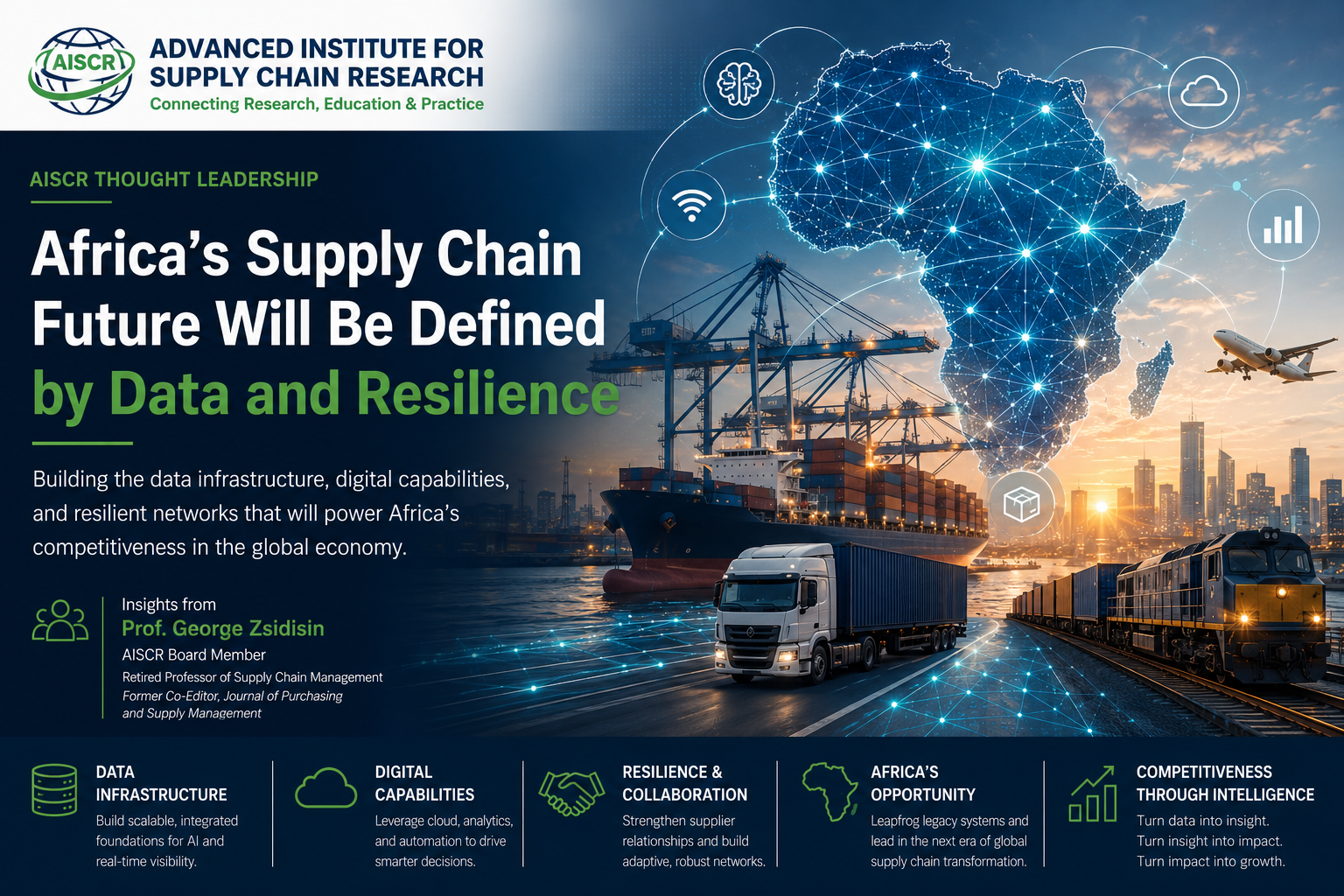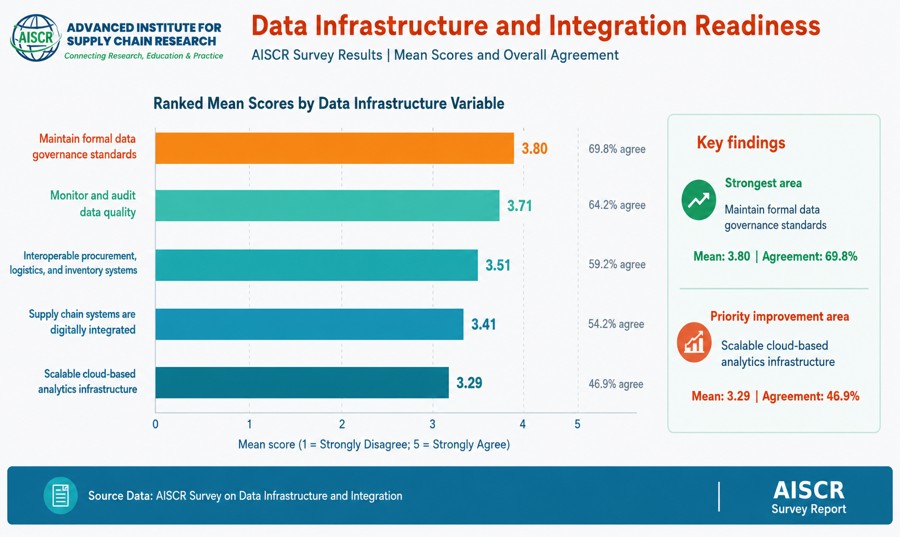
AISCR Thought Leadership Africa’s Supply Chain Future Will Be Defined by Data and Resilience In…
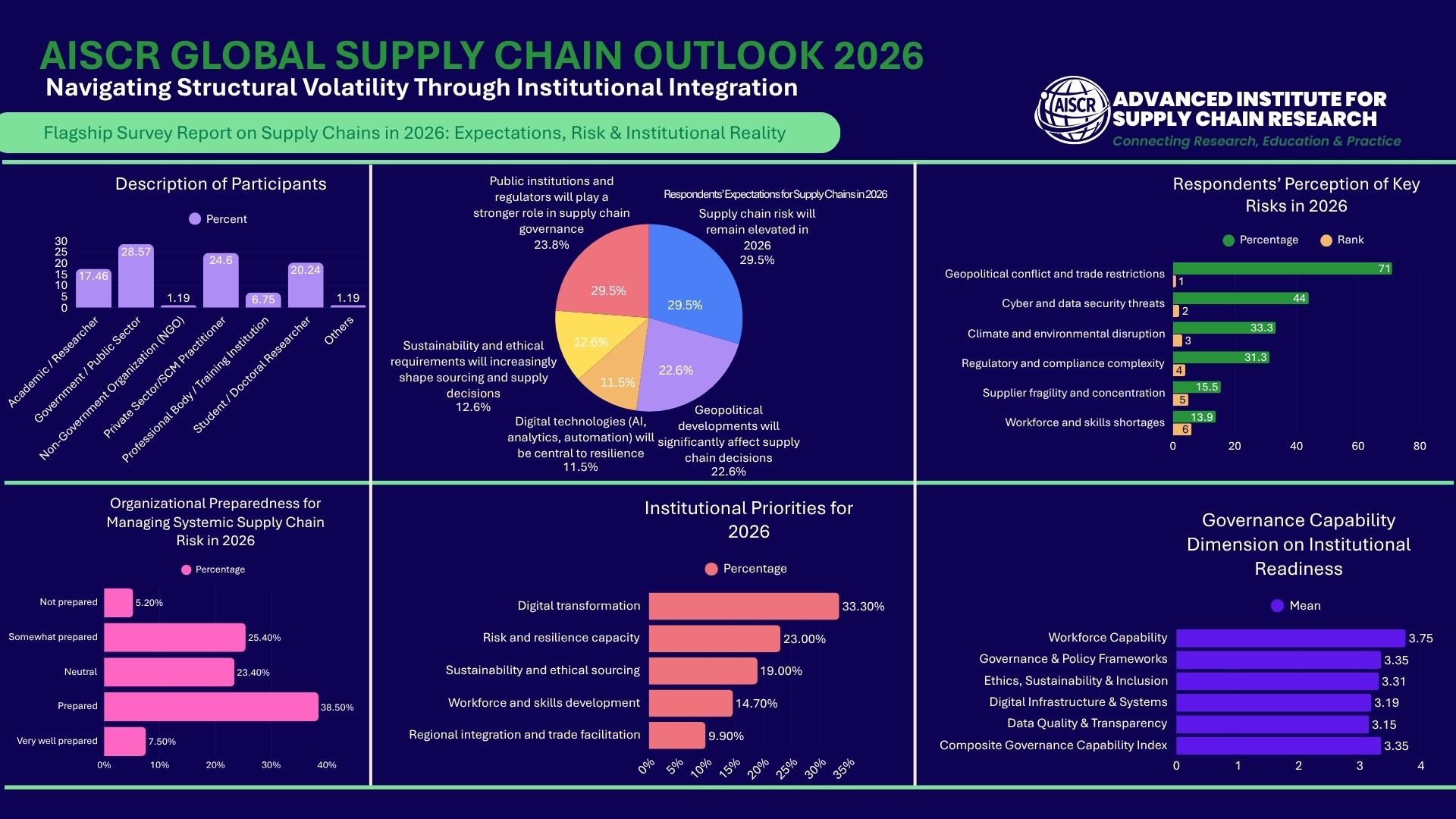
AISCR Global Supply Chain Outlook 2026
AISCR Global Supply Chain Outlook 2026
From Risk Awareness to Institutional Readiness
We are entering a fundamentally different phase of global supply chains, one in which disruption is no longer episodic, but structural. The question is no longer whether organizations face risk, but whether they are designed to operate under continuous uncertainty. The evidence suggests a troubling reality: most are not.
Across institutions, there is growing recognition of the scale and persistence of supply chain risk. Leaders understand the pressures, geopolitical fragmentation, climate volatility, regulatory complexity, and digital disruption. Yet this awareness has not translated into readiness. This gap defines the current moment.
The Governance–Readiness Gap
The central failure of modern supply chains is not informational, it is institutional.
Organizations are increasingly capable of identifying risks. What they lack is the ability to integrate governance, systems, and decision-making in ways that allow them to respond effectively. This creates what can be described as a governance–readiness gap:
- Risk is recognized
- Strategies are developed
- But execution remains fragmented
The result is a system that is aware, but not aligned.
From Operational Efficiency to Institutional Capability
For decades, supply chain performance was defined by efficiency, cost reduction, speed, and optimization. That model is no longer sufficient. Resilience today is not primarily an operational achievement. It is an institutional capability. It depends on:
- The quality of governance structures
- The integration of data and digital systems
- The alignment of leadership and decision-making
- The ability to coordinate across functions and stakeholders
Organizations that continue to treat supply chains as operational systems will struggle. Those that redesign them as institutional systems will lead.
The Fragmentation Problem
The core challenge is not a lack of effort, it is a lack of integration.
Many organizations have:
- Established governance frameworks
- Built capable teams
- Initiated digital transformation efforts
Yet these elements often exist in isolation. Procurement operates separately from strategy. Data systems are disconnected from decision-making. Risk management is reactive rather than embedded. This fragmentation prevents institutions from converting capability into performance.
Procurement at the Center of Transformation
One of the most significant shifts is the repositioning of procurement. Procurement is no longer a transactional or compliance-driven function. It is emerging as a strategic coordinating mechanism, linking markets, regulation, data, and institutional priorities. In a world of structural disruption, procurement becomes:
- A risk management interface
- A market-shaping tool
- A driver of public value and economic outcomes
Organizations that continue to treat procurement as administrative will underperform. Those that elevate it to a strategic function will gain a structural advantage.
What This Means for Leaders
The implication is clear: incremental reform is no longer enough. Building resilient supply chains requires a shift:
- From compliance to capability
- From capability to integration
- From integration to public value
This means:
- Aligning governance, procurement, and digital systems
- Investing in data infrastructure, not just processes
- Breaking down institutional silos
- Designing organizations to operate under persistent disruption
Conclusion
The defining challenge of 2026 is not disruption, it is institutional readiness. Organizations that succeed will not be those that manage risk better at the margins. They will be those that fundamentally redesign how their systems work. Resilience is no longer operational. It is institutional.
DOWNLOAD THE REPORT
AISCR Jan 2026 Research Report

Related Posts